
If you’re driving a diesel truck around Bend, Oregon, you already know that these machines are built differently. Whether you’re hauling a horse trailer up to the Cascades or navigating a fleet of delivery rigs through Central Oregon winters, your diesel engine is your most important tool. But here’s the truth: diesel engines are as complex as they are powerful.
When something goes wrong, the “guess and check” method doesn’t just waste your Saturday: it drains your bank account. At Performance Authority, we see it every day. A truck comes in with a “new” part that didn’t fix the problem, and now the owner is out $800 plus the cost of the actual repair.
If you want to stop the bleeding and get your rig back on the road, you need to stop making these seven common diagnostic mistakes.
1. Firing the “Parts Cannon” at a Symptom
This is the number one money-waster in the diesel world. You get a code for low boost pressure, so you immediately go out and buy a new turbocharger. You spend the weekend under the hood, get it all bolted up, and… the light stays on.
The problem wasn’t the turbo; it was a $40 cracked boots or a leaking intercooler.
Mistaking a symptom for the root cause is why “cheap” DIY fixes end up costing more than professional expert diesel repair service. A failed injector is often a symptom of contaminated fuel or a failing lift pump. If you don’t fix the pump, you’ll be buying another set of injectors in six months.

2. Trusting a $20 Code Reader to Tell the Whole Story
We get it: those little Bluetooth OBD-II scanners are convenient. But there is a massive difference between reading a code and performing diagnostics. A cheap scanner might tell you “P0401 – EGR Flow Insufficient,” but it won’t tell you why.
Is the valve stuck? Is the cooler clogged? Is the MAP sensor giving a false reading?
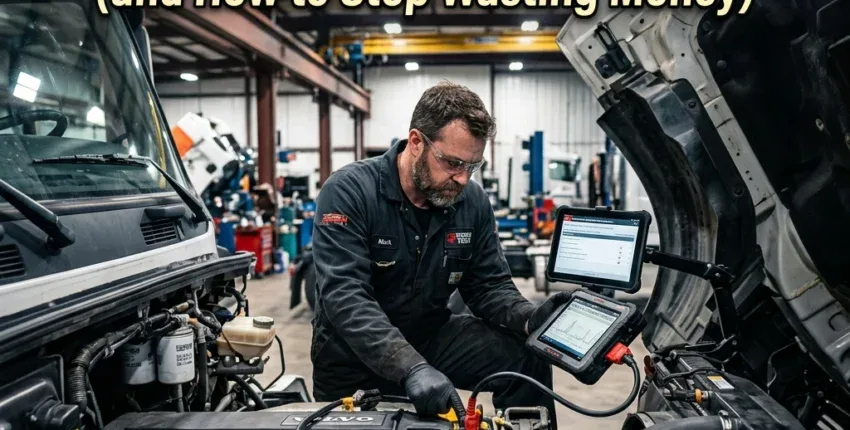
Modern diesels: especially Ford Powerstrokes, Duramax engines, and Ram Cummins units: rely on hundreds of data points. At Performance Authority, we use dealer-level diagnostic software that allows us to look at live data streams, run injector balance tests, and command specific components to move. This “data-driven” approach ensures we find the needle in the haystack on the first try.
3. Ignoring the “Little” Warning Signs
In Central Oregon, we tend to be a bit “tough.” We figure if the truck starts and pulls the trailer, it’s fine. But in the diesel world, small symptoms are early warnings of catastrophic failures.
- A slight haze of black smoke: Could be a dirty air filter, or it could be an injector starting to hang open.
- A longer-than-usual crank time: Often the first sign of a failing high-pressure oil pump or fuel system leak.
- A new whistling sound: Likely a boost leak that is forcing your turbo to overwork, leading to a premature (and expensive) failure.
Ignoring these signs is like ignoring a small leak in a dam. By the time it “actually breaks,” the repair bill will have doubled or tripled. Regular general truck maintenance is the best way to catch these issues before they leave you stranded on the side of Highway 97.

4. Neglecting the Aftertreatment System (DPF/SCR)
If you own a diesel truck built after 2007, you have a Diesel Particulate Filter (DPF). If it’s after 2011, you likely have Selective Catalytic Reduction (SCR) using DEF fluid. These systems are the most common source of “Limp Mode” and “Engine Derate” issues.
The mistake most owners make is assuming the DPF is “bad” when it clogs. In reality, a DPF usually clogs because of an upstream engine issue: like a leaking EGR valve or a faulty temperature sensor. If you just “clean” or replace the DPF without fixing the engine’s combustion issue, it will clog again in 500 miles.
Precision diagnostics allow us to see exactly how your aftertreatment system is performing, saving you from the $3,000+ cost of unnecessary component replacement.
5. Overlooking Electrical and Ground Issues
Modern diesels are essentially giant computers that happen to burn oil. We’ve seen trucks come in for “transmission failure” that turned out to be a corroded battery ground. We’ve seen “engine misfires” that were actually just a chafed wire on a sensor harness.
Because diesel engines vibrate significantly more than gas engines, wiring harnesses are prone to rubbing and grounding out. If your mechanic doesn’t check the electrical system and grounds before recommending a major mechanical overhaul, you’re likely wasting money.
6. Using “One-Size-Fits-All” Maintenance Intervals
The manual says you can go 10,000 miles between oil changes, so you do. But wait: do you spend your time idling at job sites in Bend? Do you tow a heavy camper over the Santiam Pass in 90-degree heat?
Standard intervals don’t account for the “Extreme Service” conditions we face in Oregon. Old oil loses its ability to protect high-pressure fuel injectors (especially on HEUI systems like the 6.0L and 7.3L Powerstroke). Old coolant can lead to cavitation, which literally eats holes in your engine block from the inside out.
Customizing your maintenance plan based on how you use your truck is the ultimate way to save your truck’s engine.

7. Choosing the Lowest Labor Rate in Town
We all want to save money, but in diesel diagnostics, you get exactly what you pay for. A general repair shop might have a lower hourly rate than a specialist, but if it takes them five hours to “guess” what’s wrong: and they still get it wrong: you haven’t saved a dime.
A specialist shop like Performance Authority invests tens of thousands of dollars in diesel-specific tools and technician training. We know the common failure points of a L5P Duramax versus a 6.7L Cummins. We don’t spend your money “learning” on your truck; we use our expertise to get you back to work.
How to Stop the Cycle of Wasting Money
Diagnostics shouldn’t be a gamble. When you bring your truck to us, we don’t just tell you what’s broken; we tell you why it broke and what we can do to prevent it from happening again. Whether you’re looking for truck performance upgrades to get more out of your rig or you just need it to be reliable for your commercial fleet, the key is precision.
Stop guessing. Stop wasting money on parts you don’t need. And most importantly, stop settling for a truck that underperforms.
Ready for a Real Solution?
If your truck is acting up, or if that check engine light is staring you in the face, don’t wait for a total breakdown. Partner with the local experts who understand Central Oregon driving and diesel technology.
Contact Performance Authority today to schedule a precision diagnostic appointment. Let’s get your truck running the way it was meant to: reliable, powerful, and efficient.