
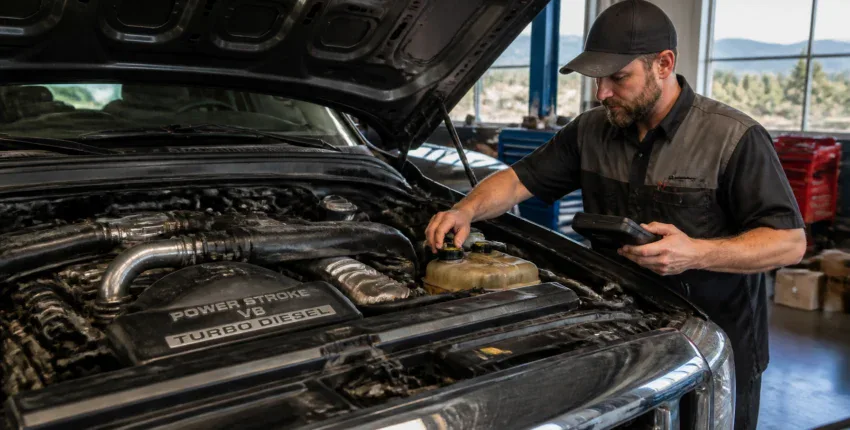
There is nothing quite like the sinking feeling of watching your temperature gauge climb into the red while you’re halfway up a mountain pass. Whether you are hauling a trailer through the Cascades or navigating the high desert roads throughout Central Oregon, an overheating engine is more than just an inconvenience: it’s a potential disaster for your rig.
At Performance Authority, we have spent over 25 years providing specialized truck repair in Bend, Oregon. We have seen it all, from the classic “low coolant” oversight to complex internal failures that require deep diesel engine diagnostics. If your Cummins, Powerstroke, or Duramax is running hotter than it should, it is time to look under the hood.
Here are the 10 most common reasons your diesel truck is overheating and exactly how to fix them.
1. Low Coolant Levels or System Leaks
It might seem obvious, but low coolant is the number one culprit behind overheating. Diesel engines generate an immense amount of heat, and without enough fluid to carry that heat away, the system fails quickly. Leaks can hide in plain sight: a cracked reservoir, a loose hose clamp, or a weeping water pump seal.
The Fix: Start by checking your degas bottle or reservoir when the engine is cold. If it’s low, top it off with the manufacturer-recommended coolant. However, don’t just “add and forget.” If the level drops again, you need professional diesel repair in Bend, Oregon to pressure-test the system and find the leak before it leaves you stranded.
2. Clogged Radiators and Restricted Airflow
In Central Oregon, our trucks deal with plenty of dust, mud, and road debris. Over time, this grime packs into the cooling fins of your radiator, AC condenser, and intercooler. If air can’t pass through those fins, the coolant can’t shed heat. On modern trucks like the 6.7L Powerstroke, the cooling stack is several layers deep, making it even easier for debris to get trapped.
The Fix: Inspect the front of your truck for visible blockages. A gentle pressure wash from the engine side out (to push debris forward) can often solve the problem. Just be careful not to bend the delicate aluminum fins. If the blockage is internal, a professional flush or radiator replacement may be necessary.
3. Stuck or Malfunctioning Thermostats
The thermostat is a simple valve that opens and closes based on engine temperature. If it gets stuck in the closed position, coolant can’t reach the radiator to cool down. This is a very common issue for high-mileage Cummins repair in Bend, where the thermostat might simply wear out and seize.
The Fix: If your engine is overheating but the radiator remains relatively cool, the thermostat is likely the hero: or villain: of the story. Replacing a thermostat is a relatively low-cost fix that should always be done with high-quality OEM parts to ensure the opening temperature matches your engine’s specs.
4. Failing Water Pump or Slipping Drive Belts
The water pump is the heart of your cooling system, circulating fluid through the block and heads. If the internal impeller blades erode or the bearing fails, flow drops significantly. Similarly, if your serpentine belt is glazed or loose, it won’t spin the pump fast enough under load.
The Fix: Listen for a “chirping” or grinding noise from the front of the engine, and check the weep hole on the water pump for signs of green or orange crust. If you suspect a flow issue, replacing the water pump and the drive belt simultaneously is the best way to ensure long-term reliability for your light duty truck repair.
5. Faulty Fan Clutch
Have you ever noticed your truck sounding like a jet engine when it gets hot? That is the fan clutch engaging. If the clutch fails, the fan won’t spin fast enough to pull air through the radiator, especially at low speeds or when idling. This is a frequent cause of overheating for drivers who do heavy towing near Bend.
The Fix: With the engine off, try to spin the fan by hand. There should be significant resistance. If it spins freely like a bicycle wheel, the clutch is shot. We specialize in Powerstroke repair in Bend, where upgrading to a heavy-duty fan clutch is a common cooling system enhancement.
6. EGR or Oil Cooler Restrictions
Modern emissions systems add a lot of complexity to the cooling loop. A clogged EGR cooler or a restricted oil cooler can cause localized “hot spots” in the engine. This is particularly prevalent in Duramax repair in Bend and some older Powerstroke models where the oil cooler fins are so small they can easily plug with old, degraded coolant.
The Fix: This requires advanced diesel engine diagnostics. We look at the “delta”: the temperature difference between your oil and your coolant. If that gap is too wide, it’s a sign that your oil cooler is restricted and needs to be replaced before it causes further damage.

7. Head Gasket Failure
This is the one every truck owner fears. If a head gasket fails, combustion gases can leak into the cooling system. This “superheats” the coolant and creates air pockets that stop the water pump from working. You might notice your heater blowing cold air while the engine temp is sky-high.
The Fix: Look for bubbles in your coolant reservoir or white smoke from the exhaust. A chemical “block test” can confirm if combustion gases are present in the coolant. If the gasket is blown, it requires a major repair involving head resurfacing and new studs. It is critical to check your cooling system before hitting the mountain passes to avoid this level of failure.
8. Clogged Air Filter or Restricted Intake
An engine is essentially a giant air pump. If it can’t breathe efficiently, it has to work harder to maintain speed, which increases exhaust gas temperatures (EGTs) and loads the cooling system. A heavily soiled air filter from driving on Central Oregon’s gravel roads can be a silent contributor to overheating.
The Fix: Inspect your air filter regularly. If it looks dark or packed with dust, swap it out. It is a simple, cheap way to keep your engine running cooler and more efficiently.
9. Fuel System and Injector Issues
If your injectors are worn or “dripping,” they can cause an uneven or late combustion event. This produces excessive heat inside the cylinders. While you might not see a “check engine” light immediately, the extra thermal load can push a marginal cooling system over the edge during a long climb.
The Fix: If your truck has a rough idle, produces excess smoke, or feels down on power while running hot, you may need a diesel injector diagnostic. Correcting fueling issues not only saves your cooling system but also protects your pistons from melting.
10. Excessive Load and Operator Error
Sometimes, the truck is doing exactly what it was designed to do, but the conditions are simply too much. Towing a 15,000-pound trailer up a 6% grade in 100-degree heat will challenge any cooling system. If you stay at wide-open throttle for too long without allowing the fan and radiator to keep up, you will overheat.
The Fix: Watch your gauges. If the needle starts to climb, back off the throttle, gear down manually to keep the RPMs up (which keeps the water pump and fan spinning faster), and turn off the AC. If it continues to rise, pull over and let the engine idle to cool down. Never shut off a boiling engine immediately, as the lack of circulation can cause localized warping.
Expert Diagnostics for Your Diesel Truck
Overheating isn’t just a sign that your truck is “working hard”: it is a warning that something is wrong. Ignoring a rising temperature gauge can lead to warped heads, cracked blocks, and thousands of dollars in repairs.
Whether you need a simple flush or a complex diagnostic for your Cummins, Powerstroke, or Duramax, the team at Performance Authority is here to help. We are local truck enthusiasts who understand the demands of Central Oregon driving.
If your rig is running hot, don’t wait for the steam to start rolling out from under the hood. Bring it by our shop for a professional inspection and let us get you back on the road with confidence.