If you own a heavy-duty truck in Bend, you know the feeling. You’re halfway up a mountain pass or hauling a heavy trailer toward the coast when that dreaded “Check Engine” light flickers on. Your first instinct might be to pull over, grab that $40 code reader you keep in the glovebox, and see what the damage is.
The screen pops up with something generic like P0299 – Turbo/Supercharger Underboost Condition. You clear it, hope for the best, and keep driving. But a few miles later, your truck enters “limp mode,” your power vanishes, and you’re stuck on the shoulder of the highway.
The truth is, while those cheap OBD-II scanners are great for a quick “heads up,” they barely scratch the surface of what’s actually happening inside a modern Cummins, Powerstroke, or Duramax engine. For drivers throughout Central Oregon, relying on a basic code reader is like trying to diagnose a complex medical issue with nothing but a thermometer. You know there’s a fever, but you have no idea why.
The Problem with Generic Codes
Most entry-level code readers are designed to meet basic emissions regulations. They speak a “universal” language that all vehicles use, which is fine for simple things like a loose gas cap or a failed oxygen sensor on a commuter car. However, modern diesel trucks are incredibly sophisticated machines with multiple networked computers managing everything from fuel rail pressure to exhaust aftertreatment systems.
When your truck throws a code, it’s often just a symptom of a much deeper issue. For example, that P0299 underboost code doesn’t tell you if you have a cracked intercooler pipe, a sticking VGT (Variable Geometry Turbo) actuator, or a simple sensor failure. A basic reader can’t tell the difference, leading many owners to fall into the trap of the “parts cannon”: replacing expensive components one by one in the hopes that something eventually fixes the problem. If you’ve found yourself in this cycle, you might want to read about the 7 mistakes you’re making with diesel diagnostics.
The Power of Bi-Directional Diagnostics
The real difference between a “code reader” and professional-grade diagnostic equipment lies in bi-directional control.
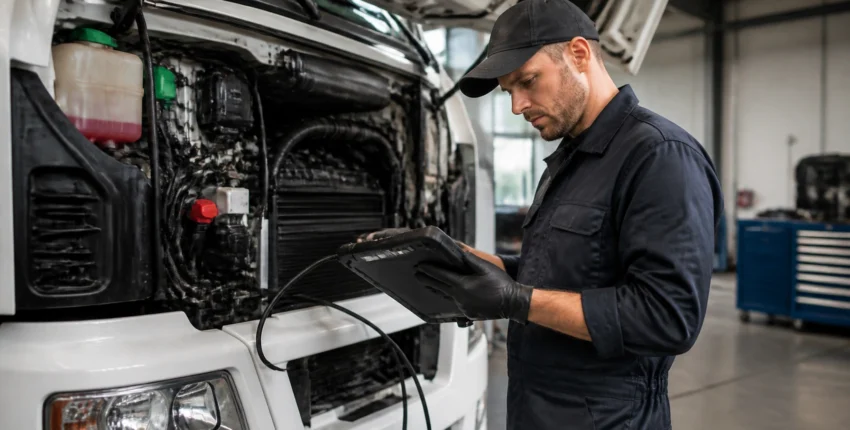
Think of it this way: a code reader just listens to the engine. A professional diagnostic tool talks to it. At our shop near Bend, we use dealership-level tools that allow us to command specific components to act. We can force a DPF (Diesel Particulate Filter) regeneration while the truck is stationary, cycle individual fuel injectors to check for contribution issues, or sweep the turbo vanes through their full range of motion to see if they’re sticking.
For a Powerstroke owner, this means we can perform a “power balance test” to identify a weak cylinder before it turns into a dead miss. For a Duramax owner, we can look at “balance rates” for injectors in real-time to see which ones are wearing out. This level of detail is essential for identifying signs your truck needs professional repair before you’re stranded.

Central Oregon’s Unique Diagnostic Challenges
Living and working throughout Central Oregon presents a unique set of challenges for diesel engines. We have high elevations, steep mountain passes, and extreme temperature swings. These factors put immense stress on your truck’s cooling and emissions systems.
High-altitude driving means thinner air, which forces your turbocharger to work harder to maintain boost. If your VGT actuator is even slightly off, the elevation will expose that flaw much faster than driving at sea level. We also see a lot of issues with DPF and DEF systems because the frequent uphill climbs increase soot production.
Without advanced diagnostics, it’s nearly impossible to tell if a DPF warning is due to a faulty NOx sensor, a clogged injector, or simply a lack of highway-speed “passive” regeneration. Our tools allow us to see the exact soot load percentages and the specific sensor readings that triggered the warning, saving you from a multi-thousand-dollar exhaust replacement that might not have been necessary.
Avoiding the “Parts Cannon” and Saving Money
The biggest advantage of professional diagnostics isn’t just finding the problem: it’s the money you save by not fixing things that aren’t broken. We often see trucks come in after the owner has already spent $1,500 on a new turbo based on a generic code, only for us to find a $200 boost leak or a faulty MAP sensor using our advanced smoke machines and data logging.
Precision matters, especially when you’re preparing your rig for towing over Central Oregon’s mountain passes. You need to know that your fuel rail pressure is holding steady under load and that your transmission is shifting exactly when the TCM (Transmission Control Module) tells it to.
Experience Meets Technology
While having the right tools is half the battle, the other half is knowing how to interpret the data. A computer can give us 100 different data points, but it takes 25 years of experience to know which three points are actually relevant to your specific problem. At Performance Authority, we’ve spent decades working on Dodge Cummins, Ford Powerstroke, and Chevy/GMC Duramax platforms. We’ve seen the “phantom” issues that only happen when it’s 20 degrees outside in Bend or when you’re pulling 15,000 pounds up toward Mt. Bachelor.
Advanced diagnostics don’t just clear a light; they provide a roadmap for a reliable repair. They give you the peace of mind that when you head out on your next adventure or start your next job, your truck is actually healthy: not just “code-free.”
Get a Clear Picture of Your Truck’s Health
If your truck isn’t running right, or if you’re tired of chasing a recurring check engine light that your handheld scanner can’t explain, it’s time for a deeper look. Don’t let a generic code lead you down a path of expensive, unnecessary repairs.
Whether you’re a local business owner with a fleet to maintain or a truck enthusiast who relies on your rig for the weekends, we’re here to help. Our specialized diesel technicians use the same high-level diagnostics the dealerships use, combined with the honest, transparent service of a local shop.
Give us a call or stop by our shop in Bend to get a definitive answer on what’s going on under your hood. Let’s get your truck back to peak performance so you can drive with confidence throughout Central Oregon.