
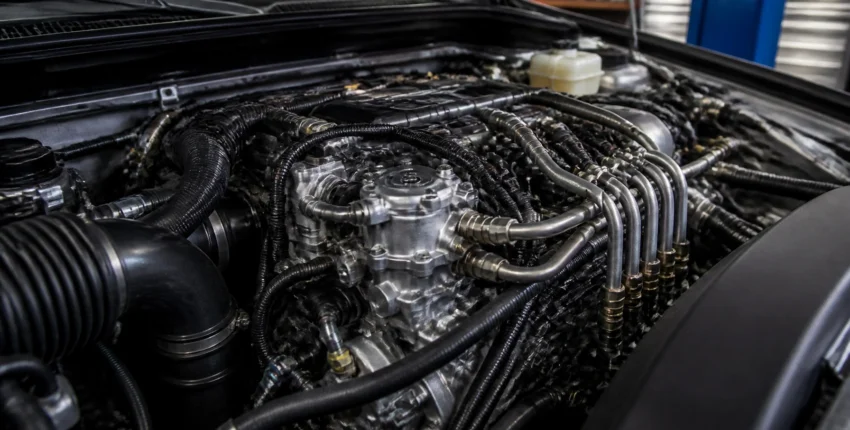
If you own a heavy-duty GM truck powered by a Duramax engine, you already know these machines are built for the long haul. Whether you’re towing a horse trailer through the Cascades or hauling heavy equipment to a job site in Redmond, the Duramax name is synonymous with torque and reliability. However, there is one component that has kept many truck owners in Central Oregon awake at night: the Bosch CP4.2 high-pressure fuel pump.
Known in the diesel community as a “ticking time bomb,” a CP4 failure is more than just a simple mechanical breakdown. When these pumps go, they often “grenade,” sending fine metallic debris throughout your entire fuel system: from the pump to the rails, injectors, and back into the fuel tank. This turns a single component failure into a massive, multi-thousand-dollar repair.
But as a Duramax owner, you might be wondering: “Is my truck actually at risk? I’ve heard the newer L5P engines are safer: is that true?” At Performance Authority, we’ve spent over 25 years performing specialized duramax repair in Bend, and we’ve seen exactly what happens when these systems fail. Here is the honest, expert breakdown of the CP4 issue and what you need to know to protect your investment.
What is the Bosch CP4 Pump and Why Does It Fail?
The Bosch CP4 high-pressure fuel pump was introduced to the Duramax platform in 2011 with the LML engine. It was designed to meet stricter emissions standards and provide higher injection pressures for better fuel atomization. On paper, it was a leap forward in efficiency. In practice, it became a significant vulnerability.
The primary reason for CP4 failure isn’t necessarily a “bad” design, but rather a mismatch between the pump’s requirements and the fuel available at the pump. The CP4 was originally engineered for European diesel, which has high lubricity standards. In the United States, our Ultra-Low Sulfur Diesel (ULSD) is much “drier.”
Because the CP4 relies entirely on the fuel itself for lubrication, the lower lubricity of US diesel causes the internal rollers to eventually lose their film of protection. When this happens, the rollers can turn sideways, creating metal-on-metal friction. This friction generates what we call “glitter”: microscopic metal shavings that are immediately pushed into your fuel injectors. Once that happens, the truck usually dies instantly, and the entire fuel system is contaminated.
Which Models are Affected? LML vs. L5P
There is often a lot of confusion regarding which model years are truly at risk. If you are researching diesel repair in Bend, Oregon, specifically for a Duramax, it is critical to know which engine you have.
The LML Duramax (2011–2016)
The 2011 to 2016 model years are the primary “danger zone” for CP4 failure. These trucks came factory-equipped with the Bosch CP4.2. For these owners, the risk is real and documented. If you drive an LML, you should be proactive about monitoring your fuel system health and considering preventative upgrades.
The L5P Duramax (2017–Present)
Here is the good news for newer truck owners: GM listened to the feedback. Starting in 2017, the L5P Duramax moved away from the Bosch CP4 and switched to a Denso HP4 high-pressure fuel pump. The Denso unit is a much more robust design and has not shown the same catastrophic failure patterns as the CP4.
So, is your L5P at risk? In terms of the classic “CP4 grenade” scenario, the answer is no. However, that doesn’t mean the L5P fuel system is invincible. High-pressure fuel systems are incredibly sensitive to water contamination and poor fuel quality. While you don’t have to worry about a “time bomb” pump, you still need to stay on top of how regular maintenance can save your trucks engine to avoid expensive injector repairs.
Warning Signs Your Fuel Pump May Be Failing
While some CP4 failures happen without any warning, many trucks will give you subtle hints before the total “meltdown” occurs. Catching these early can be the difference between a pump replacement and a total fuel system overhaul.
- Long Cranking Times: If your truck used to fire up instantly but now takes several seconds to start, your pump may be struggling to build the necessary rail pressure.
- Reduced Power or “Limp Mode”: If you see a “Reduced Engine Power” message on your dash, especially while under load, your ECM is likely detecting a fuel pressure variance.
- Metallic Ticking or Whining: A failing pump often makes a distinct, high-pitched noise that sounds different from the usual diesel clatter.
- Fuel Rail Pressure Codes: If your Check Engine Light is on and the codes are P0087 or P0088, your high-pressure system needs immediate attention.
- Metal Shavings in the Filter: During a routine fuel filter change, an experienced technician will look for “glitter” in the filter housing. If you see it, the pump is already shedding metal.
If you notice any of these signs your truck needs professional repair, do not wait. Driving on a failing pump is essentially gambling with the life of your engine.

Prevention: How to Protect Your Duramax
If you own an LML Duramax, you don’t have to just wait for the pump to fail. There are several proven ways to mitigate the risk and keep your truck on the road for years to come.
1. Add a Lift Pump
One of the biggest issues for the CP4 is that it has to “pull” fuel all the way from the tank, which can cause cavitation and air bubbles: both of which kill lubrication. Adding an aftermarket lift pump (like an AirDog or FASS system) provides a constant, positive pressure of fuel to the CP4, making its job much easier and ensuring it stays lubricated.
2. Use High-Quality Fuel Additives
Since the root cause of the failure is low lubricity in US diesel, adding a lubricity enhancer to every tank is one of the easiest and most cost-effective things you can do. At Performance Authority, we recommend additives that are specifically formulated to compensate for ULSD’s shortcomings.
3. CP3 Conversion (The Permanent Fix)
For LML owners who want absolute peace of mind, a CP3 conversion is the gold standard. This involves removing the fragile CP4 and replacing it with the older, ultra-reliable Bosch CP3 pump used in the 2001–2010 Duramax models. A CP3-swapped LML is effectively “bulletproofed” against pump-related catastrophic failure.
4. Disaster Prevention Kits
If you aren’t ready for a full CP3 swap, a “Disaster Prevention Kit” (or Bypass Kit) is a smart middle ground. This kit reroutes the pump’s return fuel through an additional filter. If the pump fails, the kit catches the metal shavings before they can reach the injectors or the fuel tank, potentially saving you thousands in collateral damage.
Why Central Oregon Conditions Matter
Living in Bend, Sisters, or Sunriver brings unique challenges for diesel engines. Our cold winters can lead to fuel gelling, which puts even more strain on a high-pressure fuel pump. If your pump is already struggling, a -5°F morning start can be the “final straw.”
Furthermore, many of our customers use their trucks for remote recreation or long hauls across the high desert. A fuel system failure on Century Drive or out near the Painted Hills isn’t just an inconvenience; it can be a safety issue. This is why we place such a high priority on diesel engine diagnostics and preventative care. We want to ensure that when you head out into the Oregon wilderness, you know your truck is coming back.
Expert Diesel Diagnostics and Repair in Bend
At Performance Authority, we don’t believe in “throwing parts” at a problem. When a customer comes in with a Duramax, we use dealership-level diagnostic equipment to see exactly what is happening inside the fuel rail.
If you are dealing with diesel injector problems like rough idle or white smoke, we can pinpoint whether it’s a simple injector failure or the beginning of a larger pump issue. Transparency is the core of our business; we’ll show you the data, explain the risks, and help you decide on the best path forward for your specific needs: whether that’s a preventative lift pump or a full CP3 conversion.
Don’t Leave Your Duramax to Chance
Whether you’re driving a 2012 LML that’s starting to act up or a 2024 L5P that you want to keep in peak condition, the fuel system is the heart of your truck. Understanding the risks of the CP4 pump: and the solutions available to you: is the best way to ensure your Duramax stays reliable for the next 200,000 miles.
If you have questions about your fuel system or want to schedule a comprehensive diagnostic check, give us a call. We’re local, we’re truck enthusiasts, and we’ve been serving the Central Oregon community for over two decades with honest expertise.
Ready to protect your truck? Contact Performance Authority today for expert diesel engine diagnostics and the best duramax repair in Bend.