
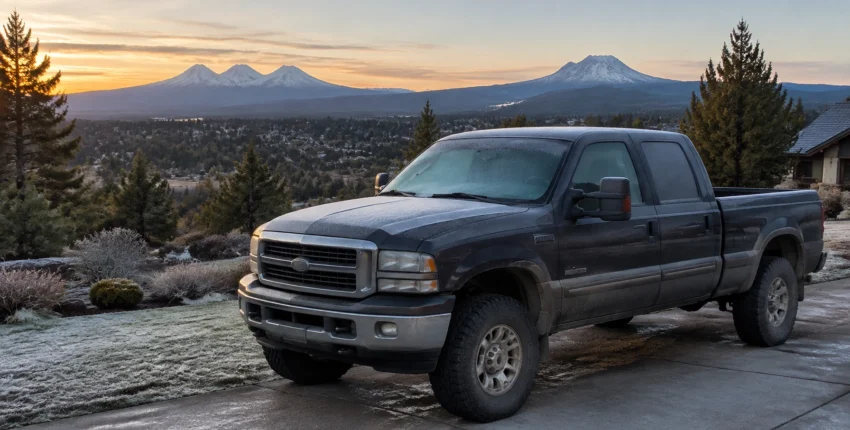
October is the right time to prepare your truck for winter in Bend and throughout Central Oregon. The first hard freeze has a way of exposing weak batteries, tired glow plugs, marginal tires, contaminated fuel, and electrical problems that were easy to overlook during warmer months.
A little preparation now can prevent a no-start morning, an expensive tow, or an avoidable breakdown on the way to a job site, hunting camp, or mountain pass. Here is the practical winter checklist we recommend for diesel and gas truck owners.
Start with the battery and cold-cranking amps
Cold weather reduces battery output just as your engine requires more effort to turn over. Diesel engines create substantial compression, and thickened cold oil adds even more resistance for the starter.
Start by checking:
- Battery age and previous cold-start performance
- Corrosion around the terminals
- Loose or damaged battery cables
- Swollen battery cases or visible leakage
- The battery’s cold-cranking amp, or CCA, rating
There is no universal CCA number that fits every truck. Compare the rating on your battery with the specification in your owner’s manual or on the under-hood label. If your truck uses two batteries, both need to be healthy. One weak battery can drag down the entire starting system.
You can check resting voltage with a multimeter, but voltage alone does not tell the whole story. A battery may show acceptable voltage and still fail under load. A proper load or conductance test is more useful, especially if the battery is several years old or the starter has begun to sound slow.
Clean, tight connections matter just as much. If you find corrosion, remove it carefully and inspect the cable ends for hidden damage. If the truck still cranks slowly after the batteries test well, the starter, alternator, or wiring may need attention. Performance Authority provides truck electrical diagnostics and repair in Bend when the problem is not as simple as a battery replacement.
Check the glow plugs, grid heater, and cold-start system
A diesel that starts easily in July may struggle in January if its cold-start system is weak.
Many Ford Power Stroke and Chevy/GMC Duramax engines use glow plugs. Some Cummins applications use an intake grid heater instead. These systems warm the air or combustion area enough to support ignition when the engine is cold.
Before winter, pay attention to:
- Longer-than-normal cranking
- Rough running for the first several seconds
- Excessive white smoke during startup
- A glow plug or intake-heater warning that behaves differently than usual
- A check-engine light or stored glow-system code
Your owner’s manual will explain the normal indicator-light sequence for your truck. If the light never appears, stays on unusually long, or the truck starts poorly even after waiting for the cycle, it is worth having the system tested.
Glow plugs, relays, grid heaters, wiring, and control modules can all cause similar symptoms. Replacing parts based only on a dash light is not always the best approach. Proper diesel engine diagnostics can identify whether the issue is a failed component, low voltage, a wiring problem, or a separate fuel or compression concern.
Test the block heater before you need it
A block heater can make a major difference during a Central Oregon cold snap, but only if it works.
Inspect the cord for cracked insulation, exposed wires, damaged prongs, or signs that it has been pulled tight. Plug it into a known-good outlet before freezing weather arrives, and follow your truck manufacturer’s instructions for testing and use. If you are checking resistance with a meter, use the specifications for your particular heater rather than assuming every unit has the same reading.
When temperatures are expected to drop well below freezing, plugging the heater in a few hours before starting can reduce strain on the battery and starter. Use a properly rated outdoor extension cord if one is necessary, and keep the connection away from standing water or snowmelt.
A block heater is not a substitute for fixing a weak battery or failed glow system. It is a tool that makes a healthy truck easier to start.
Prepare the fuel system for gelling and water
Diesel fuel contains waxes that can become less fluid as temperatures drop. Depending on the fuel, weather, and exposure, fuel can reach its cloud point and begin restricting the filter or fuel system. Water contamination can also freeze and create a no-start condition.
As winter approaches:
- Ask your fuel supplier when the local winter blend is available.
- Replace an overdue fuel filter before the coldest weather.
- Drain the water separator according to the manufacturer’s schedule.
- Keep the tank reasonably full when a hard freeze is expected.
- Use only a manufacturer-approved anti-gel additive, and follow its dosage instructions.
The timing matters. Anti-gel products are intended to be mixed into fuel before it has already begun to gel. Adding treatment to a truck with a plugged filter or frozen fuel system may not solve the problem.
Do not combine multiple additives casually, and do not use gasoline, alcohol, or unapproved fluids in a modern diesel fuel system. If the truck suddenly loses power, stalls, or will not restart after a cold night, avoid repeated cranking. That can overheat the starter and drain the batteries without addressing the underlying problem.
For a broader explanation of winter diesel preparation, Mishimoto’s diesel winter checklist and Driving Line’s cold-weather guide provide useful general background. Your truck’s owner’s manual and fuel-system requirements should always come first.
Verify oil and coolant protection
If an oil change is due before winter, confirm that the viscosity meets your truck manufacturer’s cold-weather specification. Some trucks benefit from a lower winter viscosity, but the correct choice depends on the engine, model year, operating temperature, and emissions system. Do not switch grades based on a generic recommendation alone.
Coolant also deserves a simple pre-freeze check. With the engine cold, verify the level and look for obvious leaks around the reservoir, hoses, connections, and radiator area. Check the coolant’s freeze protection with the correct tester or have it checked professionally. A low level, incorrect mixture, or neglected coolant can become a serious problem when temperatures fall.
You do not need to wait for a dramatic failure. If the heater output is weak, the engine takes unusually long to warm up, the temperature gauge behaves differently, or coolant is disappearing, schedule an inspection. Our general truck maintenance service includes fluid, filter, battery, belt, hose, and vehicle checks.
Remember that DEF can freeze
Diesel exhaust fluid can freeze at roughly 12 degrees Fahrenheit. That is normal behavior, and modern trucks are designed to warm the fluid and resume operation as the system thaws.
The important points are straightforward:
- Keep the DEF tank at a reasonable level.
- Use fresh fluid from a sealed, reputable container.
- Do not add water, fuel, or aftermarket “thawing” products.
- Address DEF quality, level, or emissions warnings promptly.
- Never ignore a countdown or reduced-power warning.
A frozen DEF tank is different from a failed DEF heater, level sensor, pump, or quality sensor. If the warning remains after the truck has warmed up, the system needs proper testing rather than guesswork.
Inspect tires, brakes, and traction equipment
Winter reliability is not only about starting. Your truck also needs to stop, steer, and maintain traction on packed snow, ice, and wet roads.
Check tire pressure when the tires are cold and adjust it to the door-jamb specification. Pressure drops as temperatures fall, so a tire that looked fine in September may be underinflated in December.
Inspect for:
- Uneven tread wear
- Cuts, bulges, or sidewall damage
- Cracked rubber or exposed cords
- Embedded objects
- Weak spare-tire condition
- Adequate tread for your typical roads and loads
If you regularly tow, travel over mountain passes, or drive unplowed roads, consider whether your current tires are appropriate for the conditions. Keep chains or approved traction devices in the truck, check their condition, and practice installing them before you are stopped beside a snowy road.
A brake and suspension inspection is also worthwhile before winter. Worn shocks, loose steering components, uneven braking, or damaged brake lines can become much harder to manage when traction is limited. Performance Authority handles 4×4, brake, and suspension service for trucks used on Central Oregon roads and trails.
Know when to bring the truck in
You can check fluid levels, tire condition, battery terminals, cords, lights, and visible leaks at home. Bring the truck in before winter if you notice:
- Slow or uneven cranking
- Hard starting below freezing
- Rough cold idle or excessive smoke
- A glow plug, grid-heater, check-engine, or DEF warning
- Repeated fuel-filter plugging
- Battery drain after sitting overnight
- Loss of power under load
- Tire, brake, steering, or 4×4 concerns
A professional inspection is especially valuable if you depend on the truck for work or operate a business fleet. Finding a weak component in October is far easier than diagnosing it on a freezing morning when the truck is scheduled for a job.
Get ready before the first hard freeze
Winter preparation does not require replacing every part on the truck. It requires knowing which systems matter, checking the basics honestly, and testing anything that has already shown warning signs.
If you need dependable diesel repair in Bend, Oregon, or reliable truck repair in Bend, Oregon, Performance Authority can help you prepare for the season. We work on Ford Power Stroke, Ram Cummins, Chevy/GMC Duramax, and other light and medium-duty trucks with dealership-level diagnostics and straightforward recommendations.
Schedule your pre-winter inspection before the first hard freeze. It is a much better time to find a weak battery, failing glow system, or restricted fuel filter than when your truck will not start and you need it most.